
24 hours a day. 7 days a week
Find answers about our marine electrical products, stock availability, delivery, installation services and regional support.
Marine light is specialized lighting fixture designed for use on boats, ships, or offshore structures. These lights are built to be highly durable, utilizing marine-grade materials like stainless steel, anodized aluminium and synthetic resin to withstand harsh, corrosive saltwater environments extreme temperatures, and constant vibration.
Marine lights serve several critical purposes in maritime operations:
Navigation Light: Required by International Maritime Organization (IMO) through the COLREGs (Convention on the International Regulations for Preventing Collisions at Sea) and SOLAS regulations, these lights indicate a vessel’s position, size, and heading at night or during poor visibility to prevent collisions. Common examples include red (port) and green (starboard) sidelights, stern light, and masthead light.
Emergency Light: Deployed during emergencies or distress situations to signal for help or illuminate escape routes.
Flood Light & Search Light: High-powered lights used to illuminate large exterior areas, docks, or act as spotlights during search and rescue operations.
Deck Lights: Illuminate the deck area to assist with onboard activities such as loading cargo, fishing, or nighttime maintenance.
Cabin & Engine Room Lights: Provide illumination for crew quarters, control rooms, and hazardous areas. Some area lights need to rate as “explosion-proof” to prevent electrical sparks from igniting flammable vapours in fuel or chemical storage areas.
Underwater Lights: Mounted on the hull for aesthetic purposes or to attract marine life during night diving or fishing.
To ensure these fixtures perform reliably, many of these fixtures are built with LED technology to maximize energy efficiency.
Navigation light (Including Signal light) for ship is essential for preventing collisions, particularly at night or during low-visibility conditions. These lights not only allow you to spot nearby ship, but they also ensure that your boat is visible to others.
In addition to visibility, navigation lights communicate important information about a ship’s size, type, activity, and direction of travel. Understanding these signals enables you to take the correct actions when approaching other boats.
These navigation lights must meet the regulatory standards for cruise vessels, offering impact resistance and energy efficiency. By law, all ship must display navigation lights with specific colours, arcs of visibility, range, and placement.
Type of Navigation Light
Light Type | Colour | Arc of Visibility | Typical Use |
Masthead Light | White | 225° | Indicates vessel’s forward direction (fore-and-aft line) |
Sidelight – Starboard | Green | 112.5° | Shows right-hand (starboard) side of vessel |
Sidelight – Port | Red | 112.5° | Shows left-hand (port) side of vessel |
Sternlight | White | 135° | Indicates vessel’s rear (stern) |
Towing Light | Yellow | 135° | Used when vessel is towing |
All-round Light | White /Other | 360° | Anchor, restricted manoeuvring, or special operations |
Depending on the length of your ship, your ship’s navigation lights must meet the following minimum visibility requirements (COLREG Rule 22):
Vessel Size | Masthead Light | Sidelights | Stern / Towing Light | All-round Light |
Ships ≥ 50 m | 6 nm | 3 nm | 3 nm | 3 nm |
Ships < 50 m & ≥ 20m | 5 nm | 2 nm | 2 nm | 2 nm |
Ships < 20m & ≥ 12m | 3 nm | 2 nm | 2 nm | 2 nm |
Boats < 12 m | 2 nm | 1 nm | 2 nm | 2 nm |
Flood Light and Search Light for ships are synergistic. Flood Light provide wide and even illumination for ship deck and work areas. Search Light project a narrow, concentrated beam over long distances for navigation, identify hazards and search and rescue.
The key differences between Flood Light and Search Light are as follow:
| Flood Light | Search Light |
Beam Pattern | Wide, even illumination designed to eliminate harsh point sources | Narrow, concentrated and high-intensity beam |
Range | Optimized for short-range and localized are lighting | Designed for long-range viewing |
Features | Typically mounted on deck rails, T-tops or spreaders. Essential for mooring and safe movement on deck during night. | Often with manual control or remote-electric controlled joystick operation so that the operator can scan horizon and vertical to spot buoys or avoid distant hazards from the helm. |
Engine Room Light and Deck Light for ships are heavy-duty, marine-grade fixtures designed to withstand splashing of water, intense vibration and high temperature especially inside the engine room. The fixtures are usually IP56/66/67 rated and corrosion-resistant.
The light body material is made from special engineering plastic, powder coated sheet or stainless steel. Stainless steel is recommended for outdoor deck installation.
Illuminant are available in LED Tube where replacement is highly accessible or LED Module where high lumen output is needed.
Engine Room Light and Deck Light design and the manufacturing process are in accordance with China Classification Society <Code for Classification of Sea-Going Steel Ships> and relevant IEC standards.
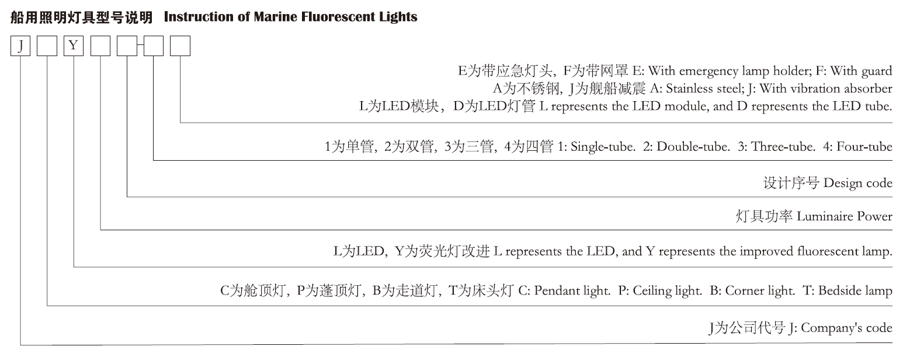
Cabin Light on a ship is an interior lighting fixture installed inside a passenger stateroom, crew quarters, or below-deck living space to provide illumination, comfort, and safety.
Types of Cabin Lights
Key Features
Cargo Light for ships is a portable floodlight used in ship cargo holds and damp areas. It is preferred to encased in non-metallic / non-conductive materials (such as synthetic resin) to prevent the unit from carrying an electrical surge, which insulate workers from hazard and eliminates the need for grounding. Cargo holds are harsh, wet and humid environment, so it is preferred to use low voltage system (12V / 24V) to reduce the risk of lethal electric shocks to crew members if equipment is damaged or exposed to water.
Explosion-Proof Light on a ship is specialized, heavy-duty lighting enclosed in a rugged, sealed housing designed to prevent internal sparks, electrical arcs, or high surface temperatures from igniting flammable gases, vapors, or combustible dust in hazardous marine areas.
Core Characteristics & Working Principles
Common Marine Applications
Marine Cable is a specialized electrical cable designed to transmit power, control signals, and data safely on ships, boats, and offshore marine structures.
Unlike standard household or industrial wires, marine cables are engineered specifically to survive harsh nautical environments. They resist high humidity, saltwater corrosion, extreme temperatures, oil, and continuous physical vibration.
Key Features of Marine Cables
Main Types
Marine Instrumentation Cables: Precision wires that transmit sensitive navigation, radar, and engine data.
Marine Variable Frequency Drive (VFD) cable is a specialized electrical wire used to safely link speed-control drives to AC motors on ships and offshore platforms.
Function
Key Components
Environmental Protection
Marine Data Cable is a specialized communication wire built to transmit digital information, sensor readings, and network signals safely in harsh nautical environments.
Unlike standard indoor wires, these cables withstand constant vibration, moisture, oil, and corrosive saltwater. They act as the digital nervous system for ships, offshore platforms, and marine equipment.
Key Features
Common Applications